Time Travel

A funny kind of time travel, notebooks and diaries. The poem I found in one of them is called time travel too, so I thought, a blog.

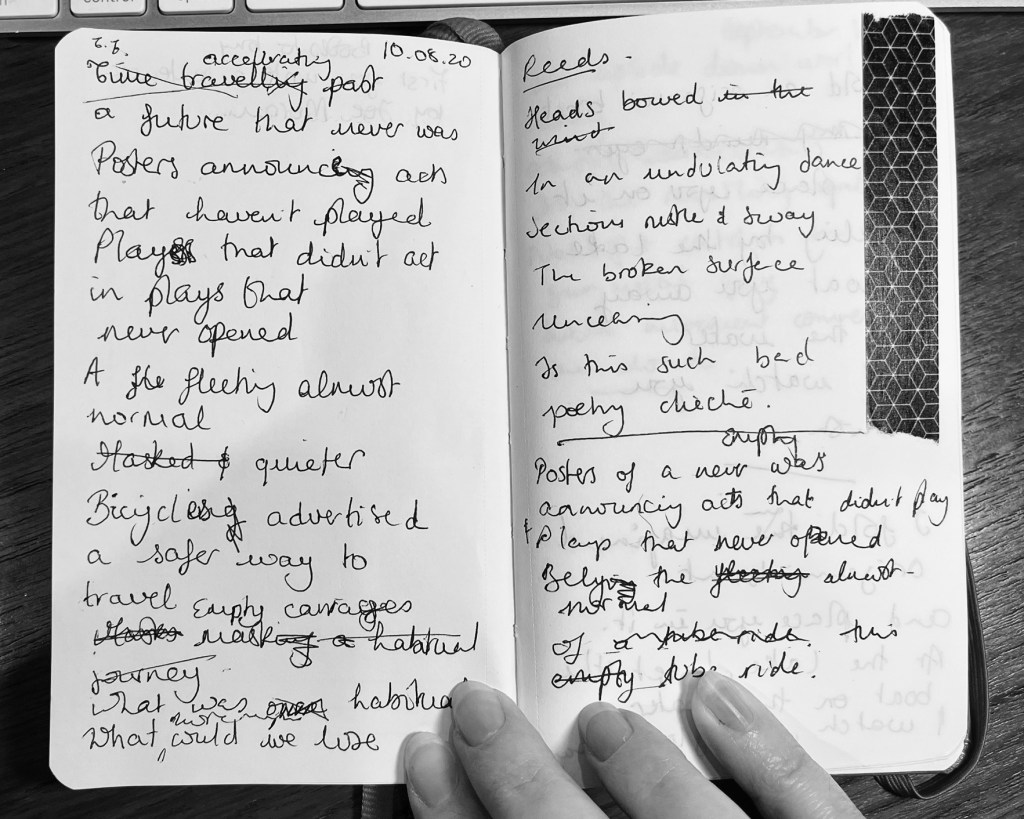
I’ve been tidying up a bit as I (re)launch into self-employed life, and I came across some poems I forgot that I wrote in 2020. As usual, there are versions of the same poem, longer and shorter, with scribbles and mis-spellings as they go from bad to – hopefully – better. Here is one that made me catch my breath. I think I wrote it on, or straight after, my first tube journey post lockdown one.

Tell me, which do you prefer Time Travel, or Empty? I’ll type them out below.

Time travel
Accelerating past a future that never was
Posters announce acts
that haven't played,
players that didn't act
in plays that
never opened.
A fleeting almost normal,
quieter.
Bicycles advertised 
a safer way to travel. 
Empty carriages mask what was habitual. 
What more could we lose
By S M R Smith on 10.08.20
Empty 
Posters of a never was
announce acts that didn't play
and plays that never opened,
belying the almost-normal
of this tube ride.
Also by S M R Smith, a month or so later.

Lift Off! 24 November 2016

caperpress_header

We are excited to announce that the Caper Press will be launching itself on the world on November 24th. Come and join us to celebrate from 7pm upstairs at Canal 125, 125 Caledonian Road.

There will be readings by our three founder authors, Drew CarrAlexandra Fitzsimmons and Sophie Smith (aka me), the chance to buy a copy of the Caper Press’s very first book, Not all, but most, music from DJ Mr Dan Savage, dancing and more. It would be great to see you there!

On ‘History and Futures – Greek Poetry and Writing in a Crisis’

FullSizeRender-1 (1)The Caper Press was at the Poetry Library yesterday for History and Futures – Greek Poetry And Writing A Crisis, organised by Penned in the Margins. You can check out some of our live tweeting here.

The event demonstrated the power of poems, poets and poetry  to respond to our times. The chair (Tom Chivers) and the poets (George Ttoouli, Theodoros Chiotis, Natalie Katsou) came equipped with thoughtful questions and nuanced reflections on tradition and continuity in Greek poetry, life in Greece today and the meaning of the word ‘crisis’. There were also some wonderful poems. The whole made for a meaningful, considered and sometimes surprising exploration of where we are right now.

Unpacking the word ‘crisis’ really resonated for me. ‘Crisis’ has become a constant over the past few years and I realised that it is a long time since I reflected on what it means. As Natalie Katsous said, ‘crisis’ suggests the short term and holds the promise, or at least the hope, of resolution. She believes the economic situation in Greece can no longer be called a crisis; it has become the ‘environment’ that the Greeks inhabit. And what of the refugee crisis or consequences of Brexit, or terrorism? When does a crisis become normality?

Crisis also suggests, or causes, interruptions. The poets discussed how the economic crisis in Greece brought new interruptions into people’s daily lives. Someone might be on the way to work on an ordinary day before being thwarted by a riot or demonstration. George Ttoouli described island roads carpeted with rotting fruit when the EU stopped subsidies for oranges. It seemed that such interruptions have now become part of the day-to-day.

When will Brexit and its political repercussions go the same way, becoming a permanent interruption to the status quo? We are surely still in the first throes of the interruption phase. The poets drew parallels between the impact of Brexit and the Greek economic crisis. Natalie Katsous likened the question ‘How are things there, after Brexit?’ to the questions she was asked in the immediate aftermath of the Greek economic crisis. And she observed that the answer is the same: it is still far too early to tell.

We’ve heard about the racist comments and vandalism that followed the referendum. But I haven’t noticed any political graffiti of the kind the poets described seeing in Athens, which was characterised by Natalie as a ‘live Facebook page that people can’t scroll down’. We do not have the same graffiti culture, ‘street art’ is apparently a new thing in Greece, their graffiti is of a different sort.

As the poets said however, the poetic responses to the Greek crisis have taken longer to formulate than the political reactions scrawled on walls.  It made me wonder what poetry is being written here to capture the uncertain state we’re in. Maybe we will see poems emerge in the coming months and years. I imagine Tom Chivers and Penned in the Margins will know when they do.

The audience questions too were thoughtful, and evidenced the importance of cross-cultural / cross-border evenings and publications like these to help us all see past doom-laden headlines. Though the poets weren’t particularly optimistic about Greece’s ‘futures’ even when one audience member asked ‘what are the positive aspects of this new normal?’

The enduring positive I will take away is the will of poets, publishers and readers to grasp for a deeper understanding of what we’re living through. As Theodoros Chiotis said ‘Poetry is always in crisis, that is the idea!’

Venue: The Poetry Library, Royal Festival Hall, Southbank Centre, London

Poets: George Ttoouli, Theodoros Chiotis, Natalie Katsou

Chair: Tom Chivers, Penned in the Margins



On holidays

See below for all four parts of my poem inspired by a wonderful week in Dubrovnik, Croatia, almost exactly 3 years ago. I didn’t have my camera, and they became my ‘word photos’.

Holiday

I.

One finished fruit drops into the ceaseless sawing cicada sound — loud beneath the gnarled branches.
Peacocks peck between twisted trunks: dusty remnants of different days.
And now for an ice cream.

II.

Discoball light catches the sides, poised
to slice through the turquoise
curve of this small bay
Four rows of coral
and cream
scale a slope
shrubbed with green.
Another slides into harbour,
or does the town move to meet it?
Sleek fortress islands, they tower over the palms.

III.

Ten minutes from the shore
the rustling wake
dominates the motor stutter.
Dark waves to starboard reveal
that night draws near.
But to port the milky sea reminds
we’ve not quite left the day behind.

IV.

The sun has stopped
lighting the horizon
and each charcoal mass
darkens to blue.
Bright Layers of green
no longer startle
above rocky ground.

The canopies,
pierced by cypress tips,
invisible now.
The islands
impose their entirety
on the dark water.

On internet dating

Soulmatch

We’ve turned the romance down a fraction.
Is there much anticipation? Hardly —
online love’s a bit of a transaction.

He asks me to dinner, I choose coffee.
His messages aren’t dim, I might like him.
Still, I’ll turn the romance down a fraction —

it’s quite likely that, in person, we’ll see
that our written rapport is far too slim.
Luckily online love’s a transaction

and I can later block him, or he me;
we’ll move on with a smile, and wit and vim,
redirecting the romance a fraction.

Since we each have to pay that monthly fee
like veg box subscriptions or the gym,
online love is basically a transaction.

Could this be real attraction? Surely that’s free.
Oh damn those six months I bought on a whim.
It’s time to turn the romance down a fraction,
for the sake of those future transactions.

Revisiting ‘Switching off the news’

Thank you to BBC News Magazine for a fascinating piece on the volunteer doctors currently saving lives in Greece. See it here.

It reminded me of this, which I wrote in early 2012, in response to the endless news reports about the Greek economy that I kept waking up to (more fool me for my choice of alarm clock radio station).

To be clear (dangerous and difficult where poems are concerned), I am not belittling the situation of those suffering the consequences of austerity in Greece, rather I am raising an eyebrow at the system that makes it so.

So:

Switching off the news*

I don’t know what they’re thinking
when they say that Greece is sinking.
All those commentators complaining
about people who are marching
would do better to check the satellite imaging
to see if it’s still there.

So I don’t know what they’re thinking
when they say that Greece is sinking:
take a flight over Athens at night
and you’ll see its lights a-twinkling.
It is definitely still there.

No I don’t know what they’re thinking
when they say that Greece is sinking;
yes the economy is bleeding
and those on gardening leave, weeding.
But ask any geologist & they’ll tell you
its landmass isn’t going anywhere
fast.

*The title is inspired by a Wendy Cope poem called ‘Unbearable or Things that make me switch the radio off’.

And yes, I have now switched station to wake up to.